PAIML Sovereign AI Ecosystem
This appendix provides a comprehensive comparison between the traditional Python/Jupyter ML ecosystem and the PAIML Sovereign AI Stack built on Rust, including migration tooling to convert existing codebases.
Visual Overview
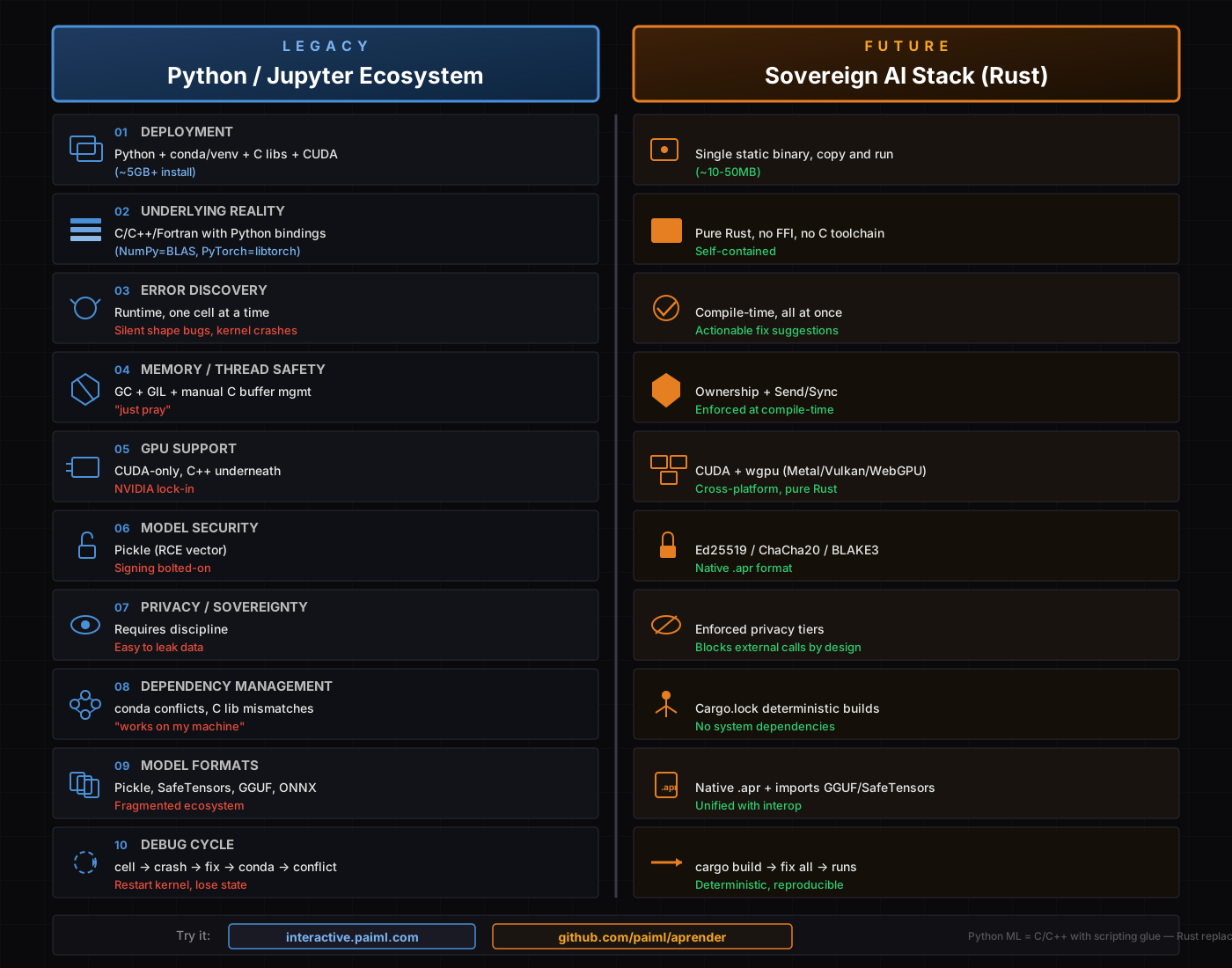
Executive Summary
The core insight: Python ML is actually a C/C++/Fortran stack with scripting glue. The PAIML ecosystem replaces the entire tower with pure Rust, delivering compile-time guarantees, single-binary deployment, cryptographic sovereignty, plus migration tooling to convert existing codebases.
| Trade-off | Python Wins | Rust Wins |
|---|---|---|
| Ecosystem breadth | ✓ Imports GGUF/SafeTensors/ONNX (500k+ HF models) | |
| Deployment simplicity | ✓ Single binary | |
| Correctness guarantees | ✓ Compile-time | |
| Security by design | ✓ Native crypto | |
| Edge/airgap deployment | ✓ Zero dependencies | |
| Migration path | ✓ Automated transpilers | |
| Python ecosystem familiarity | ✓ Existing skills/code |
Complete Ecosystem Architecture
┌─────────────────────────────────────────────────────────────────────────┐
│                        MIGRATION LAYER                                   │
│  ┌─────────┐  ┌─────────┐  ┌─────────┐  ┌─────────┐  ┌─────────────────┐ │
│  │ depyler │  │  decy   │  │ bashrs  │  │  ruchy  │  │ New Rust-first  │ │
│  │ Py→Rust │  │  C→Rust │  │ Rust→sh │  │ Scripting│  │   Scripting    │ │
│  └─────────┘  └─────────┘  └─────────┘  └─────────┘  └─────────────────┘ │
└─────────────────────────────────────────────────────────────────────────┘
                                    │
┌─────────────────────────────────────────────────────────────────────────┐
│                        TOOLING LAYER                                     │
│  ┌──────────────────┐  ┌──────────────────┐  ┌────────────────────────┐ │
│  │  pmcp (rust-mcp) │  │      pforge      │  │         pmat           │ │
│  │  MCP Protocol    │  │  Declarative MCP │  │   Quality Analysis     │ │
│  │  16x faster      │  │  YAML→Rust MCP   │  │   TDG/Mutation/Lint    │ │
│  └──────────────────┘  └──────────────────┘  └────────────────────────┘ │
└─────────────────────────────────────────────────────────────────────────┘
                                    │
┌─────────────────────────────────────────────────────────────────────────┐
│                     SOVEREIGN AI STACK                                   │
│  ┌─────────────────────────────────────────────────────────────────────┐ │
│  │                        batuta v0.1.3                                 │ │
│  │                      Orchestration/CLI                               │ │
│  ├─────────────────────────────┬───────────────────────────────────────┤ │
│  │      realizar v0.2.2        │           pacha v0.1.1                │ │
│  │   GGUF/SafeTensor Inference │     Model Registry (Ed25519/ChaCha)   │ │
│  ├─────────────────────────────┴───────────────────────────────────────┤ │
│  │                       aprender v0.14.1                              │ │
│  │         ML Algorithms: regression, trees, clustering, .apr          │ │
│  ├─────────────────────────────────────────────────────────────────────┤ │
│  │                        trueno v0.7.4                                │ │
│  │              SIMD/GPU Compute: CUDA + wgpu (Metal/Vulkan)           │ │
│  └─────────────────────────────────────────────────────────────────────┘ │
│              Pure Rust │ No FFI │ No C deps │ Single Binary              │
└─────────────────────────────────────────────────────────────────────────┘
Layer 1: Sovereign AI Stack (ML Infrastructure)
Python/Jupyter Ecosystem
┌─────────────────────────────────────────┐
│           Python Scripts                │  ← What you write
├─────────────────────────────────────────┤
│  NumPy │ Pandas │ sklearn │ PyTorch     │  ← Python APIs
├─────────────────────────────────────────┤
│  BLAS/LAPACK │ libtorch │ cuDNN         │  ← C/C++/Fortran
├─────────────────────────────────────────┤
│           CUDA Toolkit                  │  ← NVIDIA only
└─────────────────────────────────────────┘
Sovereign AI Stack (Rust)
┌─────────────────────────────────────────┐
│            batuta v0.1.3                │  ← Orchestration/CLI
├──────────────────┬──────────────────────┤
│  realizar v0.2.2 │    pacha v0.1.1      │  ← Inference │ Registry
├──────────────────┴──────────────────────┤
│           aprender v0.14.1              │  ← ML Algorithms
├─────────────────────────────────────────┤
│            trueno v0.7.4                │  ← SIMD/GPU Compute
└─────────────────────────────────────────┘
        Pure Rust │ No FFI │ No C deps
Component Reference
| Layer | Python | Rust (Sovereign) | Function |
|---|---|---|---|
| Compute | NumPy, CuPy, JAX | trueno | SIMD/GPU primitives |
| ML Algos | scikit-learn, XGBoost | aprender | Classical ML |
| Inference | transformers, vLLM | realizar | Model serving |
| Registry | MLflow, HuggingFace Hub | pacha | Model management |
| Orchestration | Airflow, Ray, Kubeflow | batuta | Workflow coordination |
| Data Loading | pandas, Datasets | alimentar | ETL pipelines |
| Analytics DB | DuckDB, Polars | trueno-db | GPU-accelerated queries |
Model Import: Full HuggingFace Compatibility
The ecosystem breadth argument is eliminated. The Sovereign AI Stack imports all major model formats:
| Format | Source | Import Status |
|---|---|---|
| GGUF | llama.cpp, HuggingFace | ✓ Native via realizar |
| SafeTensors | HuggingFace standard | ✓ Native via realizar |
| ONNX | Cross-framework | ✓ Supported |
| PyTorch (.pt/.pth) | Convert to SafeTensors | ✓ Via conversion |
# Load any HuggingFace model
batuta pacha pull meta-llama/Llama-3-8B-Instruct-GGUF
batuta pacha pull mistralai/Mistral-7B-v0.1  # SafeTensors

# Convert and import with provenance
batuta pacha import model.safetensors --sign --encrypt
Result: Access to 500k+ HuggingFace models with single-binary deployment, no Python runtime.
Layer 2: Tooling (MCP & Quality)
pmcp (rust-mcp-sdk) — MCP Protocol Implementation
What it is: Production-grade Rust implementation of the Model Context Protocol (MCP), 16x faster than TypeScript.
| Feature | Specification |
|---|---|
| Performance | 16x faster than TypeScript SDK, 50x lower memory |
| Transports | stdio, HTTP/SSE, WebSocket, WASM |
| Auth | OAuth 2.0, Bearer tokens, OIDC discovery |
| Type Safety | Automatic JSON schema from Rust types |
| Quality | Toyota Way principles, zero unwrap() policy |
#![allow(unused)]
fn main() {
// Type-safe MCP server example
let server = ServerBuilder::new()
    .name("weather-server")
    .tool("get-weather", TypedTool::new(...))
    .build()?;
server.run_stdio().await?;
}Links: github.com/paiml/rust-mcp-sdk | crates.io/crates/pmcp
pforge — Declarative MCP Framework
What it is: Define MCP servers in YAML instead of code. Built on pmcp.
forge:
  name: my-server
  version: 0.1.0
  transport: stdio

tools:
  - type: native
    name: greet
    description: "Greet someone"
    handler:
      path: handlers::greet_handler
    params:
      name: { type: string, required: true }
| Handler Type | Description |
|---|---|
| Native | Rust functions with full type safety |
| CLI | Execute shell commands |
| HTTP | Proxy HTTP endpoints |
| Pipeline | Chain multiple tools |
Links: github.com/paiml/pforge | paiml.github.io/pforge
pmat — Code Quality Analysis Toolkit
What it is: Zero-configuration AI context generation and code quality analysis for 17+ languages.
| Capability | Description |
|---|---|
| Context Generation | Deep analysis for Claude, GPT, LLMs |
| Technical Debt Grading | A+ through F scoring, 6 metrics |
| Mutation Testing | Test suite quality (85%+ kill rate target) |
| Repository Scoring | Health assessment (0-211 scale) |
| Semantic Search | Natural language code discovery |
| MCP Integration | 19 tools for AI agents |
# Generate AI-ready context
pmat context --output context.md --format llm-optimized

# Grade technical debt
pmat analyze tdg

# Run mutation testing
pmat mutate --target src/ --threshold 85
Links: github.com/paiml/paiml-mcp-agent-toolkit | crates.io/crates/pmat
Layer 3: Migration Transpilers
The Rust Migration Path
The PAIML ecosystem provides transpilers to migrate existing codebases to Rust:
┌─────────────────────────────────────────────────────────────────┐
│                   MIGRATION SOURCES                              │
├────────────┬────────────┬────────────┬────────────┬─────────────┤
│   Python   │     C      │   Bash     │  (New)     │    Rust     │
│  depyler   │   decy     │   bashrs   │   ruchy    │  (Target)   │
│    ↓       │     ↓      │     ↓      │     ↓      │             │
│   .py      │    .c      │    .sh     │  .ruchy    │    .rs      │
│    ↓       │     ↓      │     ↓      │     ↓      │             │
│ ══════════════════════════════════════════════════════════════  │
│                     SAFE, IDIOMATIC RUST                         │
└─────────────────────────────────────────────────────────────────┘
depyler — Python to Rust Transpiler
What it is: Compiles Python to Rust with semantic verification and memory safety analysis.
| Feature | Details |
|---|---|
| Single-command compile | depyler compile script.py → native binary |
| Semantic verification | Property-based testing for equivalence |
| Type-directed | Uses Python annotations for Rust types |
| 27 stdlib modules | json, datetime, hashlib, etc. (100% validated) |
| MCP Integration | Available as MCP server for AI assistants |
# Compile Python to standalone binary
depyler compile script.py -o myapp

# Transpile with verification
depyler transpile example.py --verify
Python (example.py):
def fibonacci(n: int) -> int:
    if n <= 1:
        return n
    return fibonacci(n - 1) + fibonacci(n - 2)
Rust (generated):
#![allow(unused)]
fn main() {
fn fibonacci(n: i32) -> i32 {
    if n <= 1 {
        return n;
    }
    fibonacci(n - 1) + fibonacci(n - 2)
}
}Links: github.com/paiml/depyler | crates.io/crates/depyler
decy — C to Rust Transpiler
What it is: Transpiles legacy C to safe, idiomatic Rust with minimal unsafe blocks.
| Feature | Details |
|---|---|
| Ownership inference | Converts pointers to &T, &mut T, Box, Vec |
| Lifetime inference | Automatic lifetime annotation |
| Unsafe minimization | 4-phase reduction: 100% → <5% unsafe |
| Project-level | decy transpile-project src/ with caching |
| Target projects | CPython, Git, SQLite, NumPy |
# Transpile single file
decy transpile input.c -o output.rs

# Transpile entire project
decy transpile-project src/ -o rust_output/

# Debug transpilation
decy debug --visualize-ownership input.c
Unsafe Reduction Pipeline:
- Phase 1: Pattern-based (100% → 50%) — malloc/free → Box
- Phase 2: Ownership inference (50% → 20%) — &T, &mut T
- Phase 3: Lifetime inference (20% → 10%)
- Phase 4: Safe wrappers (10% → <5%)
Links: github.com/paiml/decy
bashrs (rash) — Bidirectional Shell Safety Tool
What it is: Write shell scripts in Rust with automatic safety, OR purify legacy bash.
| Direction | Description |
|---|---|
| Rust → Shell | Write safe shell scripts in Rust syntax |
| Bash → Safe Shell | Purify messy bash to deterministic POSIX |
Automatic Safety Guarantees:
- Shell injection protection
- Word splitting prevention
- Glob expansion safety
- Idempotent operations
# Transpile Rust to shell
bashrs build install.rs -o install.sh

# Purify legacy bash
bashrs purify messy.sh -o clean.sh

# Lint shell scripts
bashrs lint script.sh
Before (messy bash):
SESSION_ID=$RANDOM                      # Non-deterministic
mkdir /app/releases/$RELEASE            # Non-idempotent
After (purified):
session_id="session-${version}"         # Deterministic
mkdir -p "/app/releases/${release}"     # Idempotent
Links: github.com/paiml/bashrs | crates.io/crates/bashrs
ruchy — Rust-First Scripting Language
What it is: Modern scripting language that transpiles to Rust. Python expressiveness + Rust safety.
| Feature | Details |
|---|---|
| Self-hosting compiler | Written in Rust, full bootstrapping |
| Interactive REPL | Syntax highlighting, completion |
| WASM support | Browser and edge deployment |
| Notebook integration | Jupyter-style with testing |
| DataFrame support | 80% complete, 200K+ property tests |
| Zero unsafe | All generated code is thread-safe |
// Variables and functions
let x = 42
let name = "Ruchy"
println(f"Hello, {name}!")

fun add(a, b) {
    a + b
}

// Pattern matching
match value {
    Some(x) => println(f"Got {x}"),
    None => println("Nothing"),
}
# Interactive REPL
ruchy

# Run script
ruchy script.ruchy

# Compile to binary
ruchy compile script.ruchy -o myapp

# Package management (Cargo integration)
ruchy new my_project
ruchy add serde tokio
Links: github.com/paiml/ruchy | crates.io/crates/ruchy
The 10-Point Comparison (Python vs Rust)
1. Deployment
| Python | Rust |
|---|---|
| Python runtime (~100MB) | Single static binary |
| conda/venv environment | (~10-50MB total) |
| pip dependencies (GB+ for ML) | No runtime needed |
| CUDA toolkit (~4GB) | Copy file, execute |
| cuDNN (~800MB) | |
| Dockerfile to wrangle it all |
Bottom line: ~5GB+ install vs ~50MB binary.
2. Underlying Reality
| Python | Rust |
|---|---|
| NumPy = BLAS/LAPACK (Fortran) | Pure Rust throughout |
| PyTorch = libtorch (C++) | No FFI boundaries |
| TensorFlow = C++ core | No C toolchain required |
| Python is the glue, not the engine | Self-contained |
Bottom line: You’re not really writing Python ML—you’re configuring C++.
3. Error Discovery
| Python/Jupyter | Rust |
|---|---|
| Runtime errors | Compile-time errors |
| One cell at a time | All errors at once |
| Silent shape mismatches | Type-checked dimensions |
| Stack trace dumps | Actionable fix suggestions |
| Kernel crashes lose state | Build fails safely |
Example:
# Python: runs, produces wrong result silently
result = model.predict(X.T)  # Oops, transposed
#![allow(unused)]
fn main() {
// Rust: compile error with fix suggestion
error[E0308]: mismatched types
  --> src/main.rs:12:18
   |
12 |     model.predict(&x)?;
   |                   ^^ expected `Matrix<100, 10>`, found `Matrix<10, 100>`
   |
help: consider using `x.transpose()`
}
4. Memory & Thread Safety
| Python | Rust |
|---|---|
| Garbage collector | Ownership system |
| Global Interpreter Lock (GIL) | Send + Sync traits |
| Manual C buffer management | Compile-time enforcement |
| Data races possible | Data races impossible |
| “just pray” | Zero-cost abstractions |
Bottom line: Rust eliminates entire categories of bugs at compile time.
5. GPU Support
| Python | Rust |
|---|---|
| CUDA only | CUDA (when available) |
| NVIDIA hardware lock-in | wgpu backend |
| C++ underneath | Metal (Apple) |
| Complex driver dependencies | Vulkan (cross-platform) |
| WebGPU (browser) | |
| Pure Rust implementation |
Bottom line: Rust gives you CUDA performance where available, portable fallbacks elsewhere.
6. Model Security
| Python | Rust |
|---|---|
| Pickle (arbitrary code execution) | Ed25519 digital signatures |
| Signing is afterthought | ChaCha20-Poly1305 encryption |
| Trust-on-download | BLAKE3 content addressing |
| No provenance chain | Native .apr format |
| Cryptographic lineage |
Security primitives in .apr format:
- AES-256-GCM encryption at rest
- Ed25519 signatures for authenticity
- X25519 key exchange for distribution
- CRC32 checksums for integrity
- License blocks and watermarking
7. Privacy & Sovereignty
| Python | Rust |
|---|---|
| Requires discipline | Enforced by design |
| Easy to accidentally leak | Privacy tiers block calls |
| No built-in controls | Configurable per-deployment |
Privacy Tiers:
| Tier | Behavior | Use Case |
|---|---|---|
| Sovereign | Blocks ALL external APIs | Healthcare, Government |
| Private | VPC/dedicated endpoints only | Financial services |
| Standard | Public APIs allowed | General deployment |
#![allow(unused)]
fn main() {
let selector = BackendSelector::new()
    .with_privacy(PrivacyTier::Sovereign);
// Only returns: Realizar, Ollama, LlamaCpp (local)
}
8. Dependency Management
| Python | Rust |
|---|---|
| conda environment conflicts | Cargo.lock deterministic |
| C library version mismatches | Reproducible builds |
| “works on my machine” | No system dependencies |
| Diamond dependency hell | Semantic versioning enforced |
| Rebuild env from scratch regularly | Build once, run anywhere |
Python nightmare:
$ conda install pytorch
Solving environment: failed
Conflict: libstdc++ 11.2 vs 12.1
Rust reality:
$ cargo build --release
   Compiling aprender v0.14.1
    Finished release [optimized] target(s) in 45.32s
9. Model Formats
| Python | Rust |
|---|---|
| Pickle (unsafe, Python-only) | Native .apr format |
| SafeTensors | Imports SafeTensors ✓ |
| GGUF | Imports GGUF ✓ |
| ONNX | Imports ONNX ✓ |
| Fragmented, incompatible | Universal import + unified native format |
Key insight: The Sovereign AI Stack can load any model from HuggingFace via GGUF/SafeTensors import. You get access to 500k+ models WITHOUT the Python runtime.
.apr format capabilities:
- Memory-mapped loading (600x faster)
- Zero-copy deserialization
- Built-in Ed25519 signing & ChaCha20 encryption
- Compression (zstd)
- Commercial licensing blocks
- Buyer-specific watermarking
10. Debug Cycle
| Python/Jupyter | Rust |
|---|---|
| Run cell | cargo build |
| Crash | See all errors |
| Fix one error | Fix all errors |
| Run cell | cargo build |
| Different crash | Runs correctly |
| Fix again | |
| conda update breaks something | |
| Nuke environment | |
| Rebuild from scratch | |
| Maybe works now |
Typical Python session:
Cell 1: ✓
Cell 2: ✓
Cell 3: TypeError
Cell 4: Fixed → ✓
Cell 5: OOM, kernel died
Cell 6: Restart, re-run all, different error
Cell 7: Works locally, fails in prod
Typical Rust session:
$ cargo build
error[E0308]: 3 errors
$ # fix all three
$ cargo build
    Finished
$ ./target/release/myapp
# Works. Same binary works everywhere.
Correctness Tooling Comparison
| Tool Type | Python | Rust |
|---|---|---|
| Linting | pylint, flake8 | clippy (built-in) |
| Type checking | mypy (optional, incomplete) | Compiler (mandatory, complete) |
| Property testing | hypothesis | proptest |
| Fuzz testing | atheris | cargo-fuzz |
| Mutation testing | mutmut | cargo-mutants |
| Memory checking | valgrind (external) | miri (built-in) |
| Thread sanitizer | external tools | Compiler prevents races |
Edge/Airgap Deployment
Python
# Package everything
docker build -t ml-app .  # 4GB+ image
docker save ml-app > ml-app.tar
# Transfer 4GB to airgapped system
docker load < ml-app.tar
docker run ml-app
# Hope all dependencies resolve
Rust
cargo build --release --target x86_64-unknown-linux-musl
# Transfer 50MB binary
scp target/release/ml-app airgapped-host:
ssh airgapped-host ./ml-app
# Done. No runtime. No dependencies.
Complete Ecosystem Reference
ML Infrastructure (Sovereign AI Stack)
| Component | Version | Function | Replaces |
|---|---|---|---|
| trueno | 0.7.4 | SIMD/GPU compute | NumPy, CuPy |
| aprender | 0.14.1 | ML algorithms, .apr format | scikit-learn |
| realizar | 0.2.2 | GGUF/SafeTensor inference | transformers |
| pacha | 0.1.1 | Model registry (Ed25519/ChaCha) | MLflow, HF Hub |
| batuta | 0.1.3 | Orchestration/CLI | Airflow, Ray |
| alimentar | - | Data loading/ETL | pandas, Datasets |
| trueno-db | - | GPU analytics | DuckDB |
| trueno-graph | - | Code analysis | - |
| renacer | - | Syscall tracing | strace |
MCP & Tooling
| Component | Function | Key Feature |
|---|---|---|
| pmcp | MCP protocol SDK | 16x faster than TypeScript |
| pforge | Declarative MCP framework | YAML → Rust MCP servers |
Testing & Quality Analysis
| Component | Domain | Key Feature |
|---|---|---|
| pmat | Static analysis | TDG scoring, SATD detection, complexity |
| oip | Defect intelligence | ML classification, Tarantula SBFL |
| probar | Runtime testing | WASM coverage, visual regression, TUI testing |
Tool Responsibilities (non-overlapping):
┌─────────────────────────────────────────────────────────────────┐
│  pmat          │  oip                │  probar                  │
├────────────────┼─────────────────────┼──────────────────────────┤
│  SATD detect   │  Fault localization │  Browser automation      │
│  TDG scoring   │  Defect ML          │  Visual regression       │
│  Complexity    │  Commit classify    │  WASM block coverage     │
│  Dead code     │  RAG enhancement    │  Pixel heatmaps          │
│  Duplicates    │  Ensemble models    │  TUI falsification       │
└────────────────┴─────────────────────┴──────────────────────────┘
See Testing & Quality Ecosystem Spec for detailed comparison.
Migration Transpilers
| Component | Direction | Key Feature |
|---|---|---|
| depyler | Python → Rust | Semantic verification, 27 stdlib modules |
| decy | C → Rust | Ownership inference, <5% unsafe |
| bashrs | Rust → Shell / Bash → Safe Shell | Bidirectional, deterministic |
| ruchy | Ruchy → Rust | New scripting language, WASM |
When to Choose Each
Choose Python/Jupyter When:
- Rapid prototyping and exploration (notebook UX)
- Team already fluent in Python (existing skills)
- Research/experimentation phase (quick iteration)
- Using Python-only libraries with no Rust equivalent
Choose PAIML Ecosystem When:
- Production deployment at scale
- Edge/embedded/airgapped environments
- Regulatory compliance (healthcare, finance, government)
- Security and provenance are mandatory
- Deployment simplicity is priority
- Long-term maintainability matters
- Migrating existing Python/C/Bash codebases
- Using HuggingFace models (GGUF/SafeTensors import = full access)
Quick Start Commands
Sovereign AI Stack
cargo install batuta aprender
batuta analyze --languages --dependencies --tdg
batuta oracle "How do I serve a Llama model locally?"
MCP Tooling
cargo install pmcp pforge-cli pmat

# Build MCP server with pmcp
cargo pmcp new my-mcp-workspace
cargo pmcp dev --server myserver

# Declarative MCP with pforge
pforge new my-server && pforge serve

# Code quality with pmat
pmat context --output context.md
pmat analyze tdg
Testing & Quality Tools
# Static analysis with pmat
cargo install pmat
pmat quality-gate          # Run all quality checks
pmat analyze tdg           # Technical debt grade
pmat analyze satd          # Self-admitted technical debt

# Defect intelligence with oip
cargo install oip
oip extract-training-data --repo .  # Analyze git history
oip localize --passed-coverage passed.lcov --failed-coverage failed.lcov

# Runtime testing with probar
cargo add jugar-probar --dev
# See: https://crates.io/crates/jugar-probar
Migration Tools
# Python → Rust
cargo install depyler
depyler compile script.py -o myapp

# C → Rust
cargo install decy
decy transpile-project src/ -o rust_output/

# Safe shell scripts
cargo install bashrs
bashrs build install.rs -o install.sh
bashrs purify messy.sh -o clean.sh

# New Rust-first scripting
cargo install ruchy
ruchy compile script.ruchy -o myapp
Resources
| Resource | Link |
|---|---|
| Sovereign AI Stack | |
| Interactive Examples | interactive.paiml.com |
| Aprender (ML Library) | github.com/paiml/aprender |
| Batuta (Orchestration) | github.com/paiml/batuta |
| Trueno (Compute) | crates.io/crates/trueno |
| MCP & Tooling | |
| pmcp (MCP SDK) | github.com/paiml/rust-mcp-sdk |
| pforge (Declarative MCP) | github.com/paiml/pforge |
| pmat (Quality Toolkit) | github.com/paiml/paiml-mcp-agent-toolkit |
| Migration Tools | |
| depyler (Python→Rust) | github.com/paiml/depyler |
| decy (C→Rust) | github.com/paiml/decy |
| bashrs (Shell Safety) | github.com/paiml/bashrs |
| ruchy (Scripting) | github.com/paiml/ruchy |
Quality Standards Across Ecosystem
All PAIML projects follow Toyota Way principles:
| Standard | Target | Enforcement |
|---|---|---|
| Test Coverage | ≥80% | CI/pre-commit |
| Mutation Kill Rate | ≥80-90% | cargo-mutants |
| Clippy Warnings | 0 | CI blocking |
| Cyclomatic Complexity | ≤10 | PMAT gates |
| Technical Debt (SATD) | 0 | Zero TODO/FIXME |
| TDG Grade | A- minimum | PMAT scoring |
One-Liner Summary
Python ML is a C/C++ stack with scripting glue. The PAIML ecosystem replaces the entire tower with compile-time correctness, single-binary deployment, cryptographic sovereignty, access to ALL HuggingFace models via GGUF/SafeTensors import, and automated migration from Python, C, and Bash.
Navigate: Table of Contents