Why MCP Over Alternatives
Before MCP, organizations tried several approaches to connect AI with enterprise data. Each has significant drawbacks that MCP addresses.
Alternative 1: Fine-Tuning LLMs
"What's the best way to personalize AI to understand my business data?" "Fine-tune the model on our data."
This was the conventional wisdom—and it's wrong for most use cases.
Why Fine-Tuning Made Sense (Historically)
Early LLMs performed poorly on domain-specific language. Terms have different meanings in different contexts:
| Term | General Meaning | Domain-Specific Meaning |
|---|---|---|
| Consideration | Thoughtful attention | Something of value exchanged that makes a contract legally binding (Legal) |
| Discharge | To release or let go | Release of a patient from hospital care, or fluid emitted from the body (Medical) |
| Margin | The edge of something | Difference between cost and selling price, or collateral for trading (Financial) |
Fine-tuning taught models this specialized vocabulary.
Why Fine-Tuning Is No Longer The Answer
1. Foundation models have caught up
Modern LLMs (GPT-5, Claude Sonnet/Opus 4.7, Gemini 3) are trained extensively on healthcare, financial, and legal domains. The vocabulary problem is largely solved.
2. Fine-tuning doesn't give access to your data
Even a fine-tuned model can't answer "What were our Q3 sales?" It learned patterns from training data—it didn't learn to query your Salesforce instance. Fine-tuning teaches language, not data access.
3. Models change faster than you can fine-tune
By the time you've fine-tuned GPT-4, GPT-5 is out. Your investment is frozen in an outdated base model. With MCP, you switch foundation models without changing your integration code.
4. Fine-tuning requires rare expertise
Fine-tuning requires experienced ML engineers and data scientists. MCP servers are standard software engineering—skills every organization already has.
5. Data leakage risks
Fine-tuning on sensitive data risks that data appearing in model outputs. A secret project name might suddenly surface in responses. MCP servers query data at runtime with proper access controls—nothing is baked into the model.
6. No audit trail
When a fine-tuned model produces an answer, you can't trace where it came from. MCP calls are fully logged: which tool, which parameters, which user, when.
The following diagram summarizes the fundamental architectural difference between the two approaches:
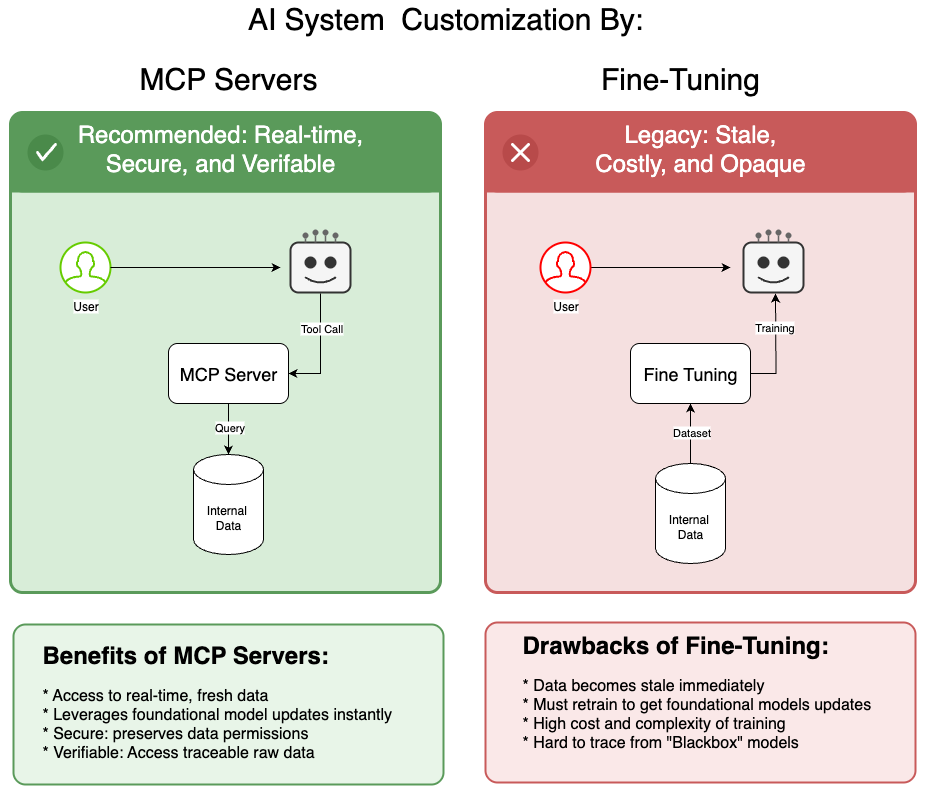
With MCP servers (left), the AI queries live data through tool calls, preserving security and traceability. With fine-tuning (right), data is baked into the model during training—immediately becoming stale and impossible to trace.
The Verdict on Fine-Tuning
Fine-tuning still has niche applications—specialized vocabulary in narrow domains where foundation models underperform. But for connecting AI to enterprise data? It's the wrong tool entirely.
Alternative 2: Retrieval-Augmented Generation (RAG)
RAG improves on fine-tuning by retrieving relevant documents at query time rather than baking knowledge into the model.
How RAG Works
┌──────────────┐     ┌──────────────┐     ┌──────────────┐
│              │     │              │     │              │
│  User Query  │────▶│   Vector     │────▶│  Retrieve    │
│              │     │   Search     │     │  Documents   │
│              │     │              │     │              │
└──────────────┘     └──────────────┘     └──────────────┘
                                                 │
                                                 ▼
┌──────────────┐     ┌──────────────┐     ┌──────────────┐
│              │     │              │     │              │
│   Response   │◀────│     LLM      │◀────│  Augmented   │
│              │     │              │     │   Prompt     │
│              │     │              │     │              │
└──────────────┘     └──────────────┘     └──────────────┘
Where RAG Falls Short
1. Documents aren't data
RAG retrieves text chunks. It can't execute SELECT SUM(revenue) FROM sales WHERE quarter='Q3'. Enterprise questions often require computation, not document retrieval.
2. Semantic search isn't always the right retrieval
"What were our Q3 sales by region?" doesn't need semantically similar documents. It needs a specific database query. RAG retrieves based on meaning; business queries often need exact matches.
3. No actions, only reading
RAG can read documents. It can't create a ticket, send an email, or update a record. MCP supports both read operations (Resources) and write operations (Tools).
4. Context window limits
RAG stuffs retrieved documents into the prompt. With limited context windows, you can only include so much. MCP returns structured data—compact and precise.
5. Stale embeddings
Vector databases need re-indexing when source documents change. MCP queries live data every time.
When RAG Makes Sense
RAG excels for knowledge bases, documentation search, and Q&A over static document collections. It complements MCP—use RAG for unstructured knowledge, MCP for structured data and actions.
Alternative 3: Hand-Written Agent Code
Many teams build custom agents with API calls embedded directly in agent code:
# The "hand-written agent" anti-pattern
class SalesAgent:
    def __init__(self):
        self.salesforce_client = SalesforceAPI(...)
        self.jira_client = JiraAPI(...)
        self.slack_client = SlackAPI(...)

    def handle_query(self, user_query: str):
        # LLM decides what to do
        intent = self.llm.classify(user_query)

        if intent == "sales_query":
            # Hard-coded API integration
            data = self.salesforce_client.query(...)
            return self.llm.summarize(data)

        elif intent == "create_ticket":
            # Another hard-coded integration
            self.jira_client.create_issue(...)

        # ... dozens more elif branches
This approach seems pragmatic but creates significant problems at scale.
Problems with Hand-Written Agents
1. Tight coupling
The agent code is tightly bound to specific APIs. Changing from Salesforce to HubSpot requires rewriting the agent, not just swapping a connector.
2. No discoverability
The LLM can only use tools the developer anticipated. MCP servers advertise their capabilities—the LLM discovers available tools dynamically.
3. No reusability
Every team builds their own Salesforce integration. With MCP, one server serves all AI applications in the organization.
4. Authentication nightmare
Each integration handles auth differently. OAuth flows, API keys, and token refresh logic scattered throughout agent code. MCP centralizes authentication at the server level.
5. No standard testing
How do you test that the agent correctly calls the Jira API? With MCP, standard tools (MCP Inspector, mcp-tester) validate any server.
6. Vendor lock-in
An agent built for ChatGPT's function calling won't work with Claude. MCP is an open standard—build once, connect to any compliant client.
7. Scaling challenges
Hand-written agents run in a single process. MCP servers can be deployed independently—scale the Salesforce server without touching the Jira server.
The Maintenance Burden
Consider maintaining 20 API integrations across 5 different AI applications:
| Approach | Integration Points | Maintenance Burden |
|---|---|---|
| Hand-written agents | 20 × 5 = 100 | Every app maintains every integration |
| MCP servers | 20 + 5 = 25 | Each server maintained once, shared by all apps |
As integrations and applications grow, MCP's advantage compounds.
MCP: The Right Abstraction
MCP succeeds because it provides the right level of abstraction:
| Challenge | Fine-Tuning | RAG | Hand-Written | MCP |
|---|---|---|---|---|
| Access live data | No | Partial | Yes | Yes |
| Perform actions | No | No | Yes | Yes |
| Audit trail | No | Partial | Manual | Built-in |
| Model flexibility | No | Yes | No | Yes |
| Reusable across apps | No | Partial | No | Yes |
| Standard protocol | No | No | No | Yes |
| Enterprise auth | N/A | Custom | Custom | OAuth 2.0 |
| Engineering skills | ML/Data Science | ML/Engineering | Engineering | Engineering |
MCP Complements, Not Replaces
MCP doesn't eliminate other approaches—it provides the integration layer:
- Fine-tuned models can be MCP clients, calling MCP servers for data
- RAG systems can be exposed as MCP Resources for document retrieval
- Existing APIs can be wrapped in MCP servers for standardized access
MCP is the universal adapter that connects AI to everything else.
The MCP Ecosystem
The Model Context Protocol, is an open protocol, published by Anthropic in late 2024, has been adopted across the industry:
- Anthropic: Claude Desktop, Claude Code, Claude mobile apps
- OpenAI: ChatGPT desktop applications
- Google: Gemini integrations
- Microsoft: GitHub Copilot, VS Code extensions
- Cursor, Windsurf, Zed: IDE integrations
Building an MCP server means building once for all these platforms.
Who Builds MCP Servers?
- Platform vendors build servers for their products (Google Workspace, GitHub, Slack)
- Enterprises build servers for internal systems (custom databases, proprietary APIs)
- You will build servers that connect AI to your organization's unique data
Knowledge Check
Test your understanding of AI integration approaches and why MCP is the right choice for enterprise:
MCP is the right protocol. But why implement it in Rust? In the next section, we explore why Rust is the ideal language for enterprise MCP servers.
Continue to Why Rust for Enterprise →